Showing posts with label Yugoslavia. Show all posts

Sunday, March 13, 2016

Yugoslavia: The 25th Anniversary of Women's Ski Race at Golden Fox

In January every year there is a ski world cup race for women called the Golden Fox. The traditional race on Pohorje has been organized annually since 1964. There are two races: slalom- and giant slalom race.

Stamp is issued 30.01.1988.


Thursday, March 3, 2016

Yugoslavia: The 200th Anniversary of the Birth of Vuk Stefanović Karadžić

Vuk Stefanović Karadžić (7 November 1787 – 7 February 1864) was a Serbian philologist and linguist who was the major reformer of the Serbian language. He deserves, perhaps, for his collections of songs, fairy tales, and riddles, to be called the father of the study of Serbian folklore. He was also the author of the first Serbian dictionary in his new reformed language. In addition, he translated the New Testament into the reformed form of the Serbian spelling and language.

He was well known abroad and familiar to Jacob Grimm, Johann Wolfgang von Goethe and historian Leopold von Ranke. Vuk was the primary source for Ranke's "Serbian Revolution", written in 1829.

Stamps are issued on 10.06.1987.


Yugoslavia: The 60th Anniversary of Yugoslav Civil Air Transport

Society for Air traffic AD Aeroput was the first Serbian company for civil air traffic, which was founded on 17 June 1927 ociety for Air Traffic "Aeroput", in the palace of the Adriatic-Danube bank in Belgrade. Aeroput was the national carrier of the Kingdom of SHS, and then the Kingdom of Yugoslavia. Aeroput was among the first civilian aircraft carriers, being the 10th airline company founded in Europe and the 21st in the world.

The airline ceased to exist during World War II in Yugoslavia, but was renewed after the war under the new name Jugoslovenski Aero Transport - JAT and still flies today as the Serbian national air carrier under the name Air Serbia.

On first maxicard is plain Potez-29, and on second McDonnell Douglas DC-10-30.

Stamps are issued on 20.03.1987.


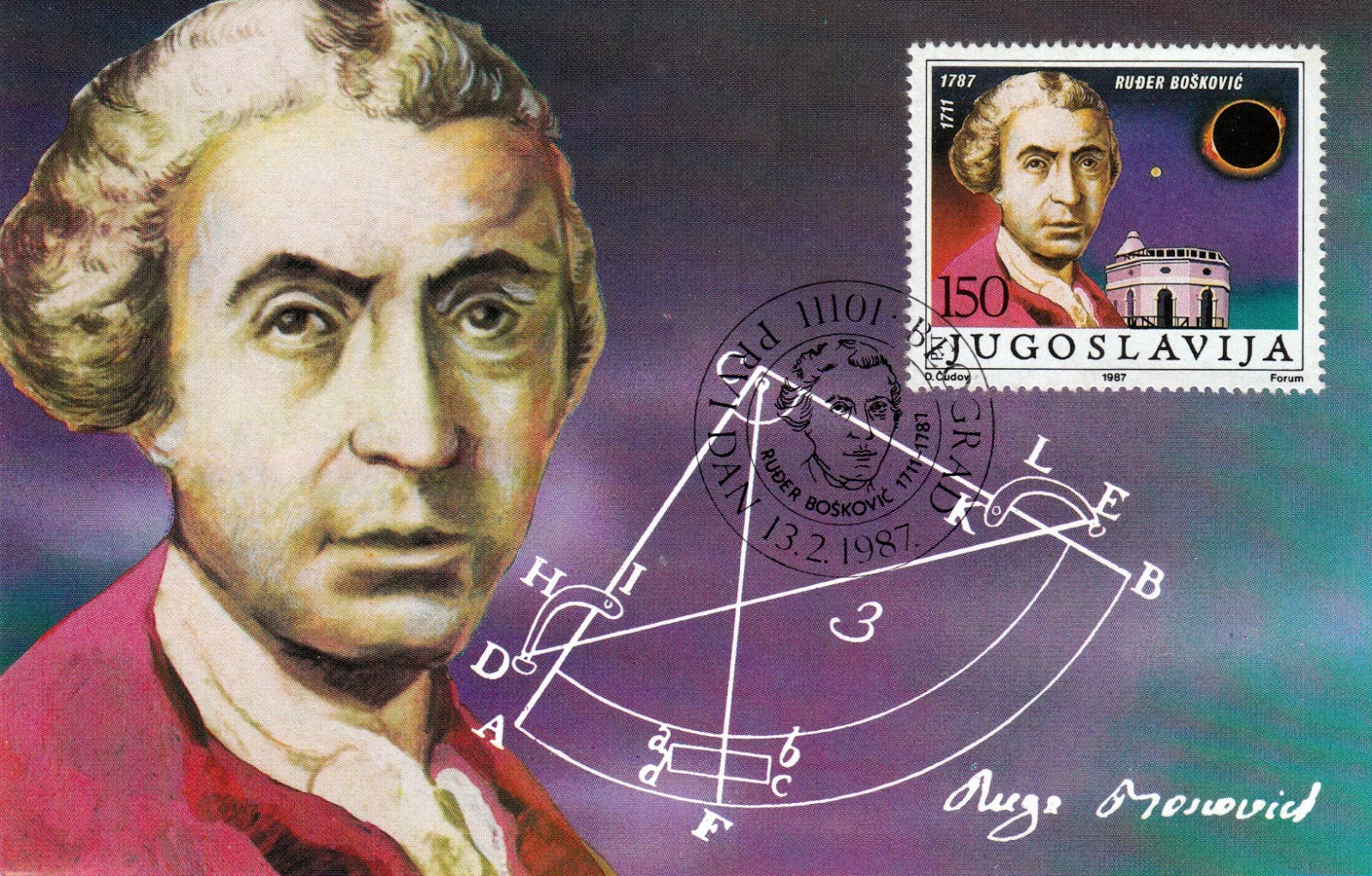
Yugoslavia: The 200th Anniversary of the Birth of Ruđer Bošković

Ruđer Bošković, (18 May 1711 – 13 February 1787) was a Serbian/Italian physicist, astronomer, mathematician, philosopher, diplomat, poet, theologian, Jesuit priest, and a polymath from the city of Dubrovnik in the Republic of Ragusa (modern-day Croatia), who studied and lived in Italy and France where he also published many of his works.

He produced a precursor of atomic theory and made many contributions to astronomy, including the first geometric procedure for determining the equator of a rotating planet from three observations of a surface feature and for computing the orbit of a planet from three observations of its position. In 1753 he also discovered the absence of atmosphere on the Moon.

Stamp is issued on 13.02.1987.


Tuesday, March 1, 2016

Yugoslavia: Rugova Folk Dance

Rugova or the Warrior dance of Rugova is a traditional sword dance of the indigenous Albanians from Kosovo. It is named after Rugova Canyon.

Stamp is issued on 10.09.1986.


Yugoslavia: The 400th Anniversary of the Birth of Primož Trubar

Primož Trubar (1508 – 28 June 1586) was the Protestant reformer, most known as the author of the first Slovene language printed book, the founder and the first superintendent of the Protestant Church of the Duchy of Carniola, notable for consolidating the Slovene language. Trubar is the key figure of Slovenian cultural history and in many aspects a major historical personality.

Stamp is issued on 28.06.1986.


Yugoslavia: The 800th Anniversary of Studenica Monastery

The Studenica Monastery is a 12th-century Serbian Orthodox monastery situated 39 km southwest of Kraljevo, in central Serbia. It is one of the largest and richest Serb Orthodox monasteries.

Stefan Nemanja, the founder of the medieval Serb state, founded the monastery in 1190. The monastery's fortified walls encompass two churches: the Church of the Virgin, and the Church of the King, both of which were built using white marble. The monastery is best known for its collection of 13th- and 14th century Byzantine-style fresco paintings.

Studenica was declared Monument of Culture of Exceptional Importance in 1979, and it is protected by Republic of Serbia, and in 1986 UNESCO included Studenica monastery on the list of World Heritage Sites.

Stamp is issued on 15.03.1986.


Friday, February 26, 2016

Yugoslavia: The 40th Anniversary of AMSJ

AMSJ was founded in Belgrade, in the distant 1921. The Automobile and Motorcycle Association of Yugoslavia is an independent, national association of motorists, managed by its members, where the main task is the protection of all AMSJ members in the field of automobile mobility and tourism, improvement of road safety through numerous preventive-safety activities, and free services for all road users.

AMSJ has become AMSS - The Automobile and Motorcycle Association of Serbia. Stamps are issued on 25.02.1986. On first maxicard you can see rescue helicopter, and on second is road assistance vehicle.


Yugoslavia: Congress of the World Dental Federation in Belgrade

FDI World Dental Federation, established in Paris in 1900 as the Fédération dentaire internationale, is the world's leading organization representing the dental profession. It serves as the principal representative body for over one million dentists worldwide, developing health policy and continuing education programmes, speaking as a unified voice for dentistry in international advocacy, and supporting member associations in oral health promotion activities worldwide. This stamp is issued to commemorate 73rd congress of FDI held in Belgrade. Date of issue is 21.09.1985.


Thursday, February 25, 2016

Yugoslavia: National Heroes of Yugoslavian Aviation

Franjo Kluz (left on the stamp) was born in Jošik, near Bosanska Dubica.

In the second half of May 1942, like Rudi Čajavec before him, he defected to the Partisans with his Potez 25 aircraft. From the improvised airfield near Prijedor he carried out a number of sorties against Axis forces, the most notable being the attack on an Ustaša column near Orahovo on 4 June. His plane was destroyed by hostile fire on 6 July.

Kluz became a member of the 1st Air Squadron of YNLA, otherwise known as No. 352 Squadron RAF. On 14 September 1944, he was shot down in his Spitfire and killed by German AAA over Omiš. For his wartime service, Franjo Kluz was posthumously awarded the Order of a People's Hero of Yugoslavia.

Rudi Čajavec (right on the stamp) was a Yugoslav pilot, best known as the first airman of Partisan air force.

After Axis invasion of Yugoslavia and establishment of Independent State of Croatia he came to Banja Luka where he joined resistance movement. On 21 May 1942 he flew his Breguet 19 biplane and defected with his gunner Mišo Jazbec to Partisans. He landed near Partisan-controlled Prijedor.

Partisans immediately started to use their own plane. On 2 July 1942 Čajavec made an air raid on Banja Luka, which included strafing the local airfield, dropping bombs on important city buildings as well as leaflets on city streets. The plane was damaged by anti-aircraft artillery, and Čajavec was forced to crashland on territory controlled by Chetniks. After they have surrounded him, Čajavec committed suicide to avoid being captured.

Stamp is issued on 21.05.1985.


Yugoslavia: The 1100th Anniversary of the Death of St. Methodius

Saints Cyril and Methodius (826-869, 815-885) were two Byzantine Christian theologians and Christian missionaries who were brothers. Through their work they influenced the cultural development of all Slavs, for which they received the title "Apostles to the Slavs". They are credited with devising the Glagolitic alphabet, the first alphabet used to transcribe Old Church Slavonic. After their deaths, their pupils continued their missionary work among other Slavs. Both brothers are venerated in the Orthodox Church as saints with the title of "equal-to-apostles". In 1880, Pope Leo XIII introduced their feast into the calendar of the Roman Catholic Church. In 1980, Pope John Paul II declared them co-patron saints of Europe, together with Benedict of Nursia.

Stamp is issued on 06.04.1985.


Yugoslavia: Novo Hopovo monastery

The Novo Hopovo Monastery is a Serb Orthodox monastery on the Fruška Gora mountain in northern Serbia, in the province of Vojvodina. According to tradition, the monastery was built by the Despots of the House of Branković. The first reliable mention of the monastery dates back to 1641.
The Novo Hopovo Monastery was declared Monument of Culture of Exceptional Importance in 1990, and it is protected by the Republic of Serbia.

Stamp is issued on 20.02.1985.


Monday, February 22, 2016

Yugoslavia: The 100 Years of Birth of Miloje Milojević

Miloje Milojević was a Serbian composer, musicologist, music critic, folklorist, music pedagogue, and music promoter. Together with Petar Konjović and Stevan Hristić, Miloje Milojević represented a generation of composers who introduced modern styles and a high compositional technical level to Serbian music. Throughout his life he preserved his affinity toward the national style—toward folklore as a foundation of art music. Stamp is issued on 27.10.1984.


Tuesday, January 19, 2016

Yugoslavia: Old Olive Tree in Mirovica

In Mirovica, near Bar, there is old olive tree. It's considered to be old more than 2000 years! Tree is protected by the state. Treetop is around 100 square meters, and volume of tree is 10 meters!

Stamp is issued on 15.09.1984.


Yugoslavia: The 100th Anniversary of the First Serbian Railway Line Belgrade-Niš

Struggle for liberation of the Serbian people, after centuries of oppression, was crowned during the 19th century with creation of two states, Serbia and Montenegro. After the Congress of Berlin, these two independent states started their life within new borders. The late 19th and early 20th centuries saw the expansion of the development of railway traffic in this area, on the territory of states of that time: Serbia, Montenegro, Austria-Hungary and Turkey.

In 1878, at the Congress of Berlin, Serbia was declared an independent state and four new districts were annexed to it – Niš, Pirot, Vranje and Toplica districts. At the Congress, Austria-Hungary helped Serbia to gain new territories, conditioning Serbia, however, to sign a new convention. The convention obliged Serbia to construct the railway line from Belgrade to Vranje and Turkish and Bulgarian borders in three years. But because of lack of money, it's only constructed  line from Belgrade to Niš.

Stamp is issued on 09.04.1984.


Monday, January 18, 2016

Yugoslavia: Europa CEPT 1984 - 25th Anniversary of the CEPT

In order to celebrate the 25 years of the CEPT, it has been decided to use a common design again as it was the case before 1974. On this two interesting maxicards, you can see all previous Europa CEPT stamps from Yugoslav Post!

Stamps are issued on 30.04.1984.


Yugoslavia: The 40 Years of Slovenian Monetary Institute

During the WWII, Slovenian Monetary Institute is established to be a bank, to print Partisan's money, and to give credits. On this maxicard you can see one of the money bills from that period. Stamp is issued on 12.03.1984.


Monday, January 11, 2016

Yugoslavia: Nature protection 1983

Kopaonik's national park was established in 1981. Deciduous forests and native coniferous woodland make up most of the forested land in the park. Kopaonik has many species of birds, such as rock partridge, scops owl, red-backed shrike, and the wood lark. Soil erosion is great threat as there is a lot of logging and deforestation in the park.

The national park is situated on a relatively flat region, at an altitude of about 1,700 m. This central Kopaonik plateau is called Suvo Rudište. It is surrounded by mountain peaks. To the north and northwest of this plateau stretches Banjski Kopaonik, which is the location of Jošanička Banja spa, whose strong springs' waters reach the temperature of 88 °C. Directly below the Suvo Rudište plateau starts the attractive and picturesque valley of the Samokovska River, characterized by its steep run, numerous rapids, falls and gorges.Kopaonik has over 200 sunny days annually and over 160 days covered by snow.

The Sutjeska National Park is a national park located in the Republika Srpska. Established in 1962, it is Bosnia and Herzegovina's oldest national park. It includes the highest peak of Maglić at over 2,386 metres, on the border with Montenegro. The Montenegrin part of Maglić massif in the park has also formed the Trnovačko Jezero. The Strict Nature Reserve “Perućica”, one of the last two remaining primeval forests in Europe, is part of the park. The park is also famous as being the location of the Battle of the Sutjeska in 1943 during World War II. It is an affiliated member of EUROPARC Federation.

Stamps are issued on 10.09.1983.


Sunday, January 10, 2016

Yugoslavia: The 100 Years of Birth of Ivan Meštrović

Ivan Meštrović  was a Croatian sculptor and architect. He was born on August 15, 1883, in Slavonia, Austria-Hungary, which is located in modern-day Croatia. At the age of sixteen, a master stone cutter from Split, Pavle Bilinić, noticed his talent and he took him as an apprentice.

In 1905 he made his first exhibit with the Secession Group in Vienna, noticeably influenced with the Art Nouveau style. His work quickly became popular, even with the likes of Auguste Rodin who once said that Meštrović is the greatest phenomenon among sculptors and even greater sculptor than he was.

He was a contemporary and friend of Nikola Tesla.


Stamp is issued on 1983-08-15.


Saturday, January 9, 2016

Yugoslavia: EUROPA CEPT 1983 Ivo Andrić

Ivo Andrić (9 October 1892 – 13 March 1975) was a Yugoslav novelist, poet and short story writer who won the Nobel Prize in Literature in 1961. His writings dealt mainly with life in his native Bosnia under Ottoman rule.

Born in Travnik in Habsburg-occupied Bosnia, Andrić attended high school in Sarajevo, where he became an active member of several South Slav national youth organizations. Following the assassination of Archduke Franz Ferdinand in June 1914, Andrić was arrested and imprisoned by the Austro-Hungarian police. As the authorities were unable to build a strong case against him, he was placed under house arrest for much of the war, only being released following a general amnesty for such cases in July 1917. After the war, he studied South Slavic history and literature at universities in Zagreb and Graz, eventually attaining his Ph.D in Graz in 1924. Between 1920 and 1941, he worked in the diplomatic service of the Kingdom of Yugoslavia.


In 1939, he was appointed Yugoslav ambassador to Germany but his tenure ended in 1941 with the German-led invasion of his country. Shortly after the invasion, Andrić returned to German-occupied Belgrade. He lived quietly in the city for the duration of World War II, writing some of his most important works, including the The Bridge on the Drina (this famous bridge is on first maxicard) . Following the war, he was named to a number of ceremonial posts in Yugoslavia, which had come under communist at war's end.

In 1961, the Nobel Committee awarded Andrić the Nobel Prize in Literature, selecting him over the likes of J.R.R. Tolkien, Robert Frost, John Steinbeck and E.M. Forster. The Committee cited "the epic force with which he traced themes and depicted human destinies drawn from his country's history". Andrić died in Belgrade in 1975.

Stamps are issued on 1983-05-05.